The long watch
A light has been kept at Frying Pan Shoals since 1854.
For roughly a hundred and ten years that watch was kept afloat, by lightships anchored in open ocean. In 1964 it passed to a steel platform standing on four legs, and the lightships were withdrawn.
The hazard
Why a light was established on Frying Pan Shoals at all.
Frying Pan Shoals reaches seaward from Cape Fear — shallow, shifting, and lying directly across the coastal shipping route. A vessel making the turn at Cape Fear either stood well out to sea or risked grounding in the dark. The shoal is the reason every structure in this history exists.
The federal answer, from 1854, was a floating light: a purpose-built vessel anchored at the seaward end of the hazard, showing a light and sounding a fog signal, staffed year-round. The Coast Guard did not yet exist. Holding that station through a century of weather, and through interruptions including the Civil War, is the first half of this account.
1854–1964
The floating watch, 1854 to 1964.
A lightship is an unusual piece of engineering: a vessel built not to travel but to hold station. Every element of its design serves a single purpose — remaining in the one position a vessel would otherwise avoid.
The last of the Frying Pan lightships, LV-115 — later WAL-537 — took the station in 1930 and served out the final generation of the floating watch. She was launched in 1929 at Charleston Drydock & Machine Company, and photographs of her on station record what the assignment looked like: a small vessel alone on open water, holding a position no chart would recommend.
1964
A drilling platform design, adapted to keep a light.
By the 1960s the Coast Guard had adopted a better answer, borrowed from the offshore oil industry: give the light a permanent foundation. The result was the Texas Tower light station — a steel platform standing on legs driven into the seabed, carrying quarters, machinery and a light tower well above the reach of the sea.
Frying Pan Shoals Light Station was built to that pattern, one of seven such stations erected along the U.S. Atlantic coast in the 1960s. Its components were barged to the shoal and assembled on site. The Coast Guard's own architectural drawings, dated May 16, 1963, carry the station's name and the design of its light tower — and serve as reference documents for the restoration today.
The station became operational on November 24, 1964. The lightship was relieved, and the floating watch at Frying Pan Shoals ended after a hundred and ten years.
The record
Photographs from the Coast Guard’s own file.
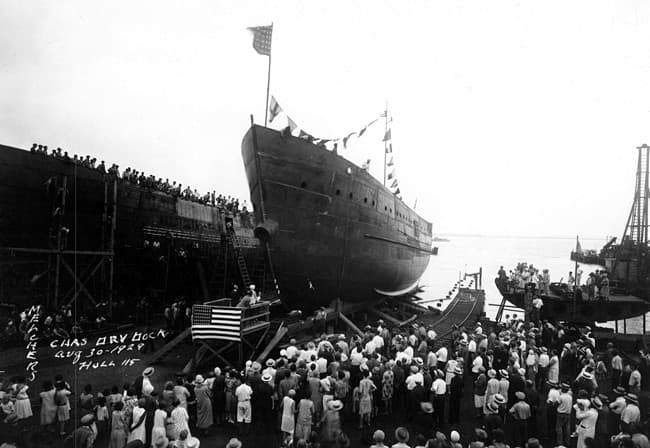
1929 — LV-115 at her launch, Charleston Drydock & Machine Company.U.S. Coast Guard photograph (public domain) 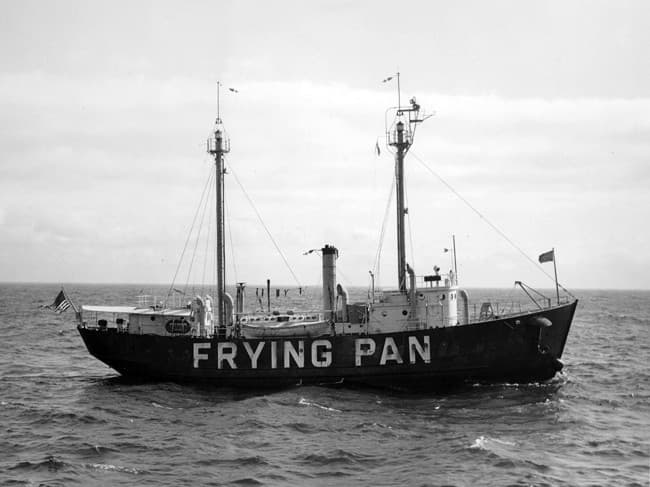
1949 — the lightship FRYING PAN on station, alone on open water.U.S. Coast Guard photograph (public domain) 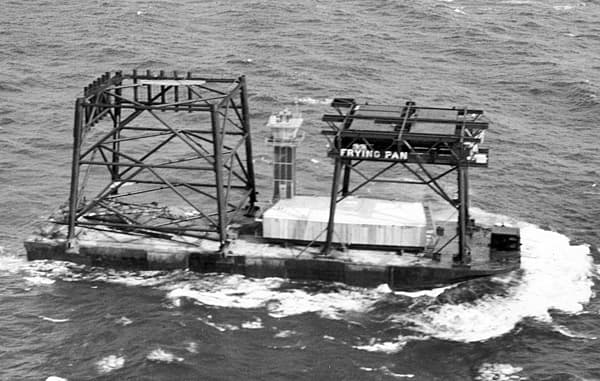
1964 — station components under tow to Frying Pan Shoals.U.S. Coast Guard photograph (public domain) 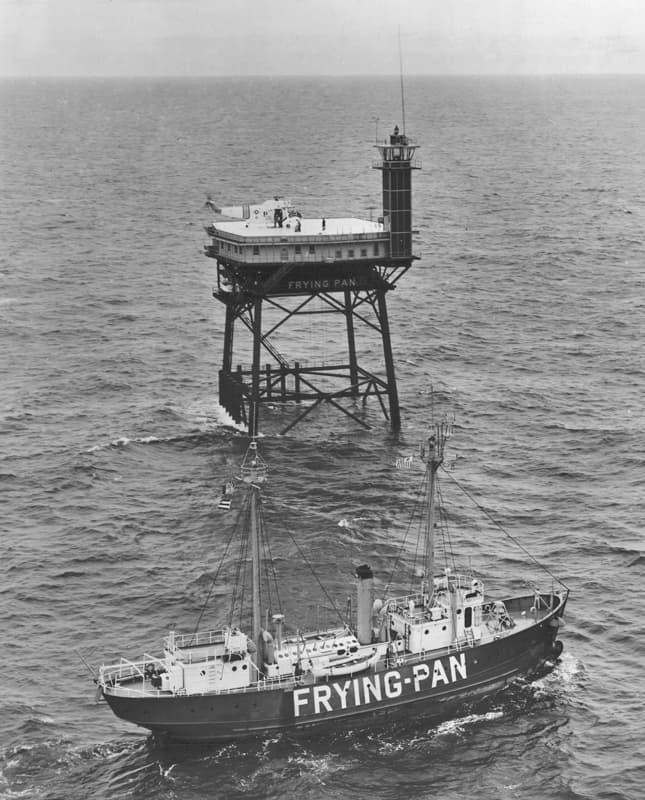
1965 — the new station stands over the lightship it relieved.U.S. Coast Guard photograph (public domain)

A former crewman remembered the station as a place of long isolation, sudden danger, and unforgettable sunrises.
Paraphrased from published recollections of former Coast Guard crew
Life on station
Fifteen years of continuous occupation, 1964 to 1979.
From 1964 the station was manned. The deckhouse held the quarters, galley, radio room and generator room; fuel and water were carried in the platform below. Crews rotated out to a steel island with no ground to walk on, eighty feet above the Atlantic, and kept the light.
Published recollections from former Coast Guard crew describe long isolation, sudden danger, and remarkable sunrises. It was demanding duty, and those who drew it recall it in detail decades later.
1979 and 2004
First the crew stood down. Then the mission ended.
Automation reached the station in 1979. The resident watch stood down and the light ran unattended — the same transition made at light stations across the country in those years, and the end of the station as a place where people lived.
Twenty-five years later the mission itself had passed. Satellite navigation and modern electronics had made a fixed offshore light redundant, and in 2004 the station was retired from active Coast Guard service. What remained was a large steel structure in open ocean with no assigned purpose and no budget — a position from which few such structures return.
2010
Sold at public auction in 2010.
In 2010 the federal government sold the station at public auction to a private buyer. It has been in private hands ever since — continuously, without interruption, from that auction to the present day. Years of demanding offshore restoration and volunteer work followed, carried out by people who declined to let the structure be lost. That work belongs in the record, and it is part of why there is still a station here to restore.
July 2026
Stewardship renewed, July 2026.
In July 2026 stewardship consolidated among the station's existing co-owners. Those stepping away sold their interests within that existing group; no new outside owners entered, and the station's continuous private ownership since 2010 was unbroken by the change.
What follows is a renewed program of urgent stabilization and long-range planning, together with the preparation of a visitor program through which the public will, in time, be able to see the station.
At a glance
Timeline, 1854 to 2026.
1854
The first lightship
Federal authorities establish a floating light at Frying Pan Shoals. (The U.S. Coast Guard did not yet exist.)
1930
LV-115 takes station
The final Frying Pan lightship—LV-115, later WAL-537—begins the last generation of the floating watch.
Nov 24, 1964
The station goes operational
The permanent Texas Tower light station—modeled on an offshore drilling platform, on four steel legs driven deep into the seabed—replaces LV-115.
1979
Automation
The resident Coast Guard watch gives way to automated operation.
2004
Active service ends
Modern navigation makes the station redundant as a federal aid to navigation; it is retired from active Coast Guard service and faces an uncertain future.
2010
A private preservation chapter
The federal government sells the station at public auction to a private buyer. It has been privately owned ever since. Years of difficult offshore restoration and volunteer work follow.
July 2026
Stewardship renewed
Ownership consolidates within the station's existing co-owners — no new outside buyers — and a renewed program of urgent stabilization and long-range planning begins.
On the name
One structure, two names.
On the Coast Guard's own drawings, dated May 16, 1963, the structure is Frying Pan Shoals Light Station. That is the name it inherited from the lightship station it replaced, the name in the federal record, and the name used throughout this site.
Over the decades the light tower has also been widely known as Frying Pan Tower. Both names point to the same steel platform on the same shoal, sixty years on station.

Keep reading
- What restoration involves What six decades of Atlantic weather require of a steel structure, and the sequence in which the work proceeds.
- Visiting the station The station's visitor program has returned and trips are open for booking. The crossing, the structure, and the requirements every visitor must meet.