


A new chapter of stewardship · July 2026Read the transition note

Frying Pan Shoals · North Carolina · 32 miles offshore

Frying PanShoalsLight Station

Standing watch since 1964.

Built to warn mariners away from one of the Atlantic coast's most dangerous shoals, this steel light station has endured six decades of salt, storms, and isolation. Today, it enters a new chapter—preserved not as a private trophy, but as a working piece of maritime history with more service left to give.

33°29′N · 77°35′W

1964
Permanent station operational
November 24, 1964
1979
Automated
2004
Retired from Coast Guard service
32 miles
Offshore
135 feet
Light above the Atlantic

One of seven U.S. Atlantic Texas Tower light stations built in the 1960s. Source: U.S. Coast Guard Historian’s Office

The responsibility

Built to protect mariners. Now it must be protected.

Offshore steel does not get a quiet retirement. Salt attacks every surface. Wind and waves exploit every weakness. Every repair requires planning, transport, skilled labor, safe access, and materials carried more than thirty miles offshore. Preservation here is not cosmetic. It is the work required to keep an irreplaceable structure standing—and to make future service possible.

Structure after U.S. Coast Guard drawing 107911 (1963)

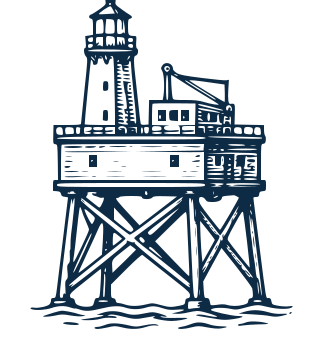
  1. 1Light tower & lanternA square lattice tower climbs from the platform's corner to the lantern room, where the main optic and its standby lamp stood watch 135 feet above the Atlantic. Open steelwork takes weather on every member, which puts the tower among the first priorities for stabilization.
  2. 2Main deck & quartersRoughly 80 feet above the water, the deckhouse held everything a resident crew needed — quarters, galley, radio room, generator room — with fuel and water tanks carried in the platform beneath. Restoring reliable power, water, and communications begins here.
  3. 3Catwalks & railingsThe walkways and rails that let crews move safely around the station live closest to the spray, so they come first, alongside the light tower. Sound footing is the precondition for every other repair.
  4. 4Legs & cross-bracingFour steel legs, driven deep into the seabed and tied together by diagonal bracing, have carried every load the Atlantic has delivered since 1964. Keeping that geometry true is what “stabilize” ultimately means.
  • Stabilize

    Inspections, corroded steel, catwalks, decking, railings, and the light tower.

  • Reconnect

    Resilient communications, monitoring, cameras, and offshore connectivity.

  • Sustain

    Power, water, sanitation, fire and life-safety systems, and storm resilience.

  • Serve

    Prepare the station for responsible scientific, educational, and preservation work.

What the work involves

The first watch

A watch kept at the edge of the shoals since 1854.

For roughly 110 years, the watch at Frying Pan Shoals was kept afloat—by lightships anchored in open ocean, with interruptions including the Civil War. The steel station replaced them.
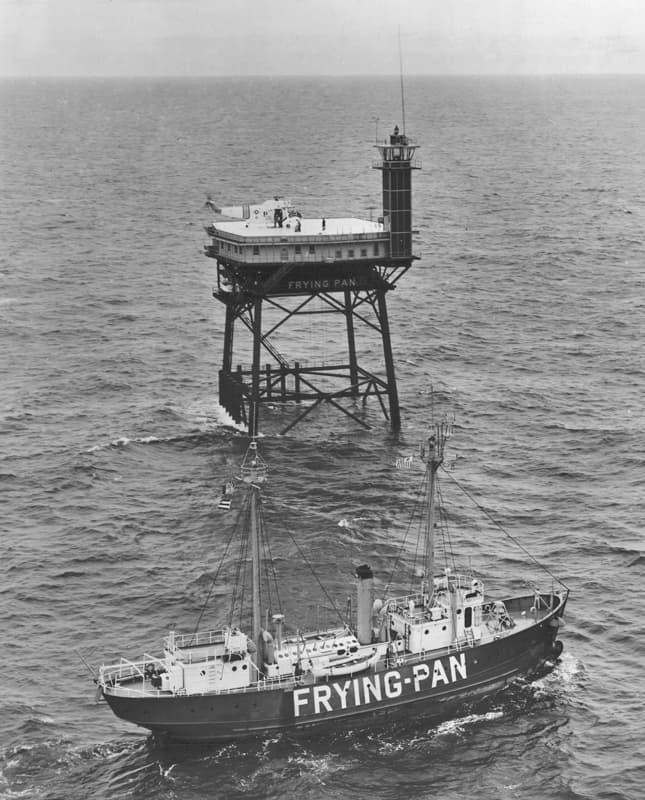
Aerial photograph, 1965: the new steel light station stands on four splayed legs above the ocean while the lightship FRYING-PAN, its name painted large on the hull, rides at anchor below it.
1965 — the lightship FRYING-PAN relieved by the new station.U.S. Coast Guard photograph (public domain)
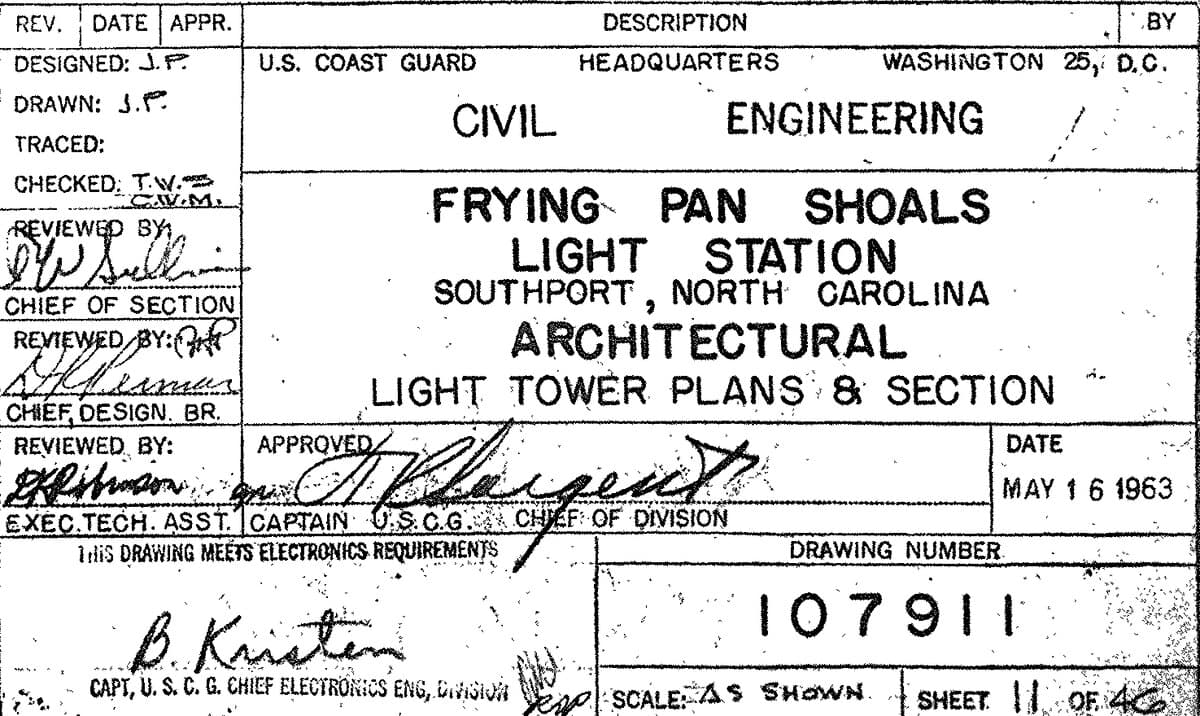
Title block of U.S. Coast Guard civil engineering drawing 107911, dated May 16, 1963, reading “Frying Pan Shoals Light Station, Southport, North Carolina — Architectural, Light Tower Plans & Section.”
The name, on the Coast Guard’s own drawings — May 16, 1963.U.S. Coast Guard engineering drawing 107911 (public domain)

Timeline · 1854 to 2026

  1. 1854

    The first lightship

    Federal authorities establish a floating light at Frying Pan Shoals. (The U.S. Coast Guard did not yet exist.)

  2. 1930

    LV-115 takes station

    The final Frying Pan lightship—LV-115, later WAL-537—begins the last generation of the floating watch.

  3. Nov 24, 1964

    The station goes operational

    The permanent Texas Tower light station—modeled on an offshore drilling platform, on four steel legs driven deep into the seabed—replaces LV-115.

  4. 1979

    Automation

    The resident Coast Guard watch gives way to automated operation.

  5. 2004

    Active service ends

    Modern navigation makes the station redundant as a federal aid to navigation; it is retired from active Coast Guard service and faces an uncertain future.

  6. 2010

    A private preservation chapter

    The federal government sells the station at public auction to a private buyer. It has been privately owned ever since. Years of difficult offshore restoration and volunteer work follow.

  7. July 2026

    Stewardship renewed

    Ownership consolidates within the station's existing co-owners — no new outside buyers — and a renewed program of urgent stabilization and long-range planning begins.

A former crewman remembered the station as a place of long isolation, sudden danger, and unforgettable sunrises.

Paraphrased from published recollections of former Coast Guard crew

Read the full history
The work already done

Restoration is a relay, not a reset.

The station reaches this moment because people refused to let it disappear. Through the first private chapter, volunteers, donors, and skilled crews kept an offshore steel station alive against everything the Atlantic could throw at it — and proved it still has service left to give. That work belongs in the record. Now comes a new chapter, carried by co-owners who have been part of the station for years: a focused, energized restoration effort to stabilize the structure, renew its systems, and ready the station for its next era of service.

The station today

Where things stand

As of July 2026

A short, dated summary of the station's present — who holds it, what is being done, and what comes next.

  • The station is privately owned, and has been continuously since the federal government sold it at public auction in 2010.

  • In July 2026 stewardship consolidated among the station's existing co-owners, who are committed to preserving the structure and opening it to the public.

  • Condition assessment and restoration planning are underway, beginning with the structural steel.

  • The station's visitor program is being prepared for its return. The interest list will be the first to know when dates are set.

  • Visits are arranged directly with the station's stewards.

  • The light is retired: the station is no longer an active U.S. Coast Guard aid to navigation, and this website is not affiliated with the U.S. Coast Guard.

The second watch

The light is retired. The station's service is not.

The next chapter is not about recreating 1964. It is about preserving what only this place can offer: an offshore platform for learning, observation, testing, and a direct encounter with the Atlantic.

  • Maritime Heritage

    Preserve the structure, its Coast Guard story, the crew experience, and the lightship lineage that came before it.

  • Marine & Atmospheric Research

    Responsibly support approved observation, monitoring, field work, and technology testing.

  • Education

    Make the station's history, engineering, ocean environment, and restoration accessible onshore and online.

  • Offshore Resilience

    Demonstrate practical remote power, water, communications, maintenance, and emergency-planning systems.

Open logbook

Stewardship should be visible.

As restoration moves forward, this page will carry the public record — major priorities, progress updates, documented milestones, and ways qualified people and institutions can take part.

Station status · Updated September 2, 2026

Condition assessment and restoration planning are underway, and the station's visitor program is being prepared for its return. The interest list will be the first to know when dates are set.

  • Assessment

    Knowing the station, inch by inch

    A full structural survey — legs, bracing, decking, and the light tower — will map what six decades of Atlantic weather have done, and set the sequence for the work ahead.

  • Stabilization

    Steel first

    Restoration starts with what keeps the station standing and crews safe: structural steel, railings and catwalks, and the lattice light tower at the platform's corner.

  • Field notes

    Dispatches from 32 miles out

    As crews take up the work offshore, this logbook will carry their dispatches — the repairs, the weather, the sunrises — so anyone can follow the station's next chapter as it unfolds.

Follow the restoration

Occasional updates from the station — milestones, field notes, and ways to take part.

Used only for station updates. Unsubscribe anytime.

The station’s visitor program is in preparation, with a separate interest list for notice of dates.

Thank you

Supporters of the Light Station

The individuals, businesses, and institutions who help make this restoration possible.

Straight answers

Questions people are right to ask.

Is the Light Station open to the public?
The station's visitor program is returning, and dates have not yet been announced. Those registered on the interest list receive notice first. Every visitor executes a liability waiver before travelling, and every departure is subject to weather and sea state: the station stands 32 miles offshore and is reached only by boat or helicopter.
Can I stay overnight at the station?
Overnight stays are part of the program in preparation, and no schedule has been set. The station's quarters were built for a resident Coast Guard crew rather than for guests, and returning them to safe and comfortable use is part of the restoration now underway. Notice of dates is sent to the interest list first.
How do people reach the station?
By boat or by helicopter, across 32 miles of open Atlantic. There is no road, no ferry and no conventional dock; arrival requires a transfer onto the structure and an ascent to the deck. Both are subject to weather and sea state, and no departure can be guaranteed on the day it is scheduled.
Who owns the station?
A group of private co-owners, several of whom have been part of the station for years. It has been in private hands continuously since the federal government sold it at public auction in 2010, and in July 2026 co-owners who were stepping away sold their interests within that existing group. What unites the people holding it now is a straightforward conviction: this is a one-of-a-kind piece of American maritime history, it is worth saving, and it should be experienced by people other than its owners.
All 14 questions