The work
Every material and every crew must be carried thirty-two miles offshore.
Offshore preservation is not a larger version of the work done ashore. It is governed by access, and access is governed by the weather.
The conditions
Salt works continuously, and from every direction.
Salt attacks every surface without pause. Wind and sea find every weakness and work at it. A structure of this kind is not preserved by a single campaign; it is preserved by sustained attention.
Every repair requires planning, transport, skilled labour, safe access, and materials moved more than thirty miles offshore into whatever window the weather allows. Work that would occupy a morning ashore becomes a mobilization. That arithmetic governs every decision described on this page.
The sequence
Stabilize, reconnect, sustain, serve.
The order is not arbitrary. Nothing can be restored on a structure that is not sound; nothing can be managed on a station that cannot be reached or monitored; and nothing can be hosted anywhere that cannot keep people safe and supplied. The four priorities below proceed in that sequence.
- Stabilize
- Inspection first, then structural steel: the legs and cross-bracing that carry every load, the decking and railings, the catwalks that stand closest to the spray, and the lattice light tower at the platform's corner. Sound structure is the precondition for everything that follows.
- Reconnect
- Resilient communications, remote monitoring and cameras. Together these make it possible to assess the structure's condition without a voyage, and to summon assistance from a location where assistance is hours away.
- Sustain
- Power, water, sanitation, fire and life-safety systems, and storm resilience — the systems that determine whether the station can be occupied at all, and for how long. The 1964 arrangement supported a resident crew; restoring that capability is a project in its own right.
- Serve
- Once the first three hold: preparing the station for responsible scientific, educational and preservation work, and for visitors. This is the objective, not the present state.
The structure
Four elements, and the conditions each one meets.
Offshore steel does not get a quiet retirement. Salt attacks every surface. Wind and waves exploit every weakness. Every repair requires planning, transport, skilled labor, safe access, and materials carried more than thirty miles offshore. Preservation here is not cosmetic. It is the work required to keep an irreplaceable structure standing—and to make future service possible.
- Light tower & lantern
- A square lattice tower climbs from the platform's corner to the lantern room, where the main optic and its standby lamp stood watch 135 feet above the Atlantic. Open steelwork takes weather on every member, which puts the tower among the first priorities for stabilization.
- Main deck & quarters
- Roughly 80 feet above the water, the deckhouse held everything a resident crew needed — quarters, galley, radio room, generator room — with fuel and water tanks carried in the platform beneath. Restoring reliable power, water, and communications begins here.
- Catwalks & railings
- The walkways and rails that let crews move safely around the station live closest to the spray, so they come first, alongside the light tower. Sound footing is the precondition for every other repair.
- Legs & cross-bracing
- Four steel legs, driven deep into the seabed and tied together by diagonal bracing, have carried every load the Atlantic has delivered since 1964. Keeping that geometry true is what “stabilize” ultimately means.
The responsibility
Built to protect mariners. Now it must be protected.
Stabilize
Inspections, corroded steel, catwalks, decking, railings, and the light tower.
Reconnect
Resilient communications, monitoring, cameras, and offshore connectivity.
Sustain
Power, water, sanitation, fire and life-safety systems, and storm resilience.
Serve
Prepare the station for responsible scientific, educational, and preservation work.


The reference
The station came with its own documentation, drawn in 1963.
The Coast Guard's civil engineering drawings for the station survive — among them drawing 107911, the architectural plans and section of the light tower, dated May 16, 1963, and the machinery and quarters deck plan recording how the deckhouse and its tanks were laid out. They are public-domain records of the United States government, and they are held in this project's archive.
Restoration guided by original drawings proceeds from record rather than inference: what was installed, how it was fastened, and what it was designed to carry.
Sustaining the work
Visits support the restoration.
Proceeds from the visitor program are directed to the station's stabilization and restoration work. The station is privately held and carries no public funding; the program is how that work is sustained.
The immediate priorities are structural. As those are met, that support extends to the systems that will allow the station to be occupied safely and, in time, to serve the educational and scientific purposes set out for it.
Follow the work
Watch the station come back.
Each milestone reached offshore is published in the station's logbook — the surveys, the steel, the systems, and the field notes from crews thirty-two miles out. Following along is the closest most people will get to the work as it happens, and it is where the restoration's progress is recorded first.
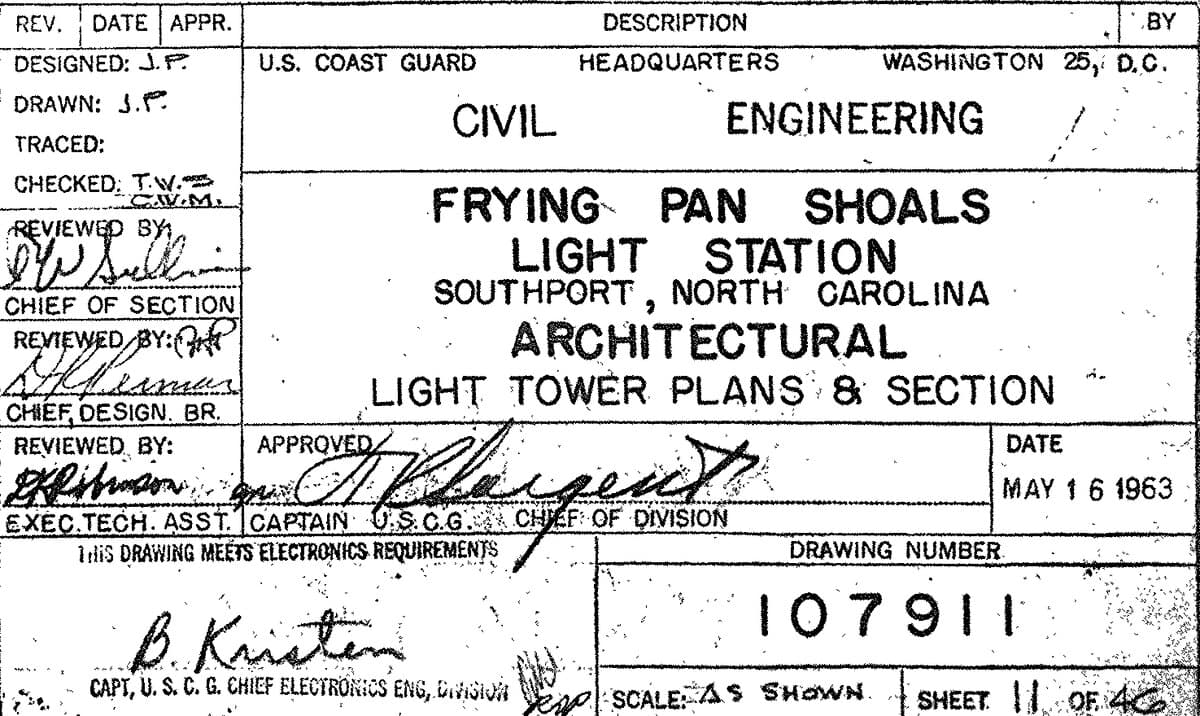
The station’s name, in the Coast Guard’s own hand.
The title block of the 1963 architectural sheet reads “Frying Pan Shoals Light Station, Southport, North Carolina.” It is both the origin of the name used on this site and the reference the restoration works from.
Station status · Updated September 27, 2026
Condition assessment and restoration planning are underway, and the station's visitor program has returned. Trips are on the calendar and open for booking.